AI can be valuable for brainstorming, analysis, and repetitive tasks, but it is not the best tool for every job. Learn its strengths, limits, and common misconceptions.
The question changed
By 2024, AI was appearing in writing tools, design platforms, search experiences, and workplace software. The novelty had worn off enough to ask a more practical question: when does using AI actually improve the result?
Where AI can help
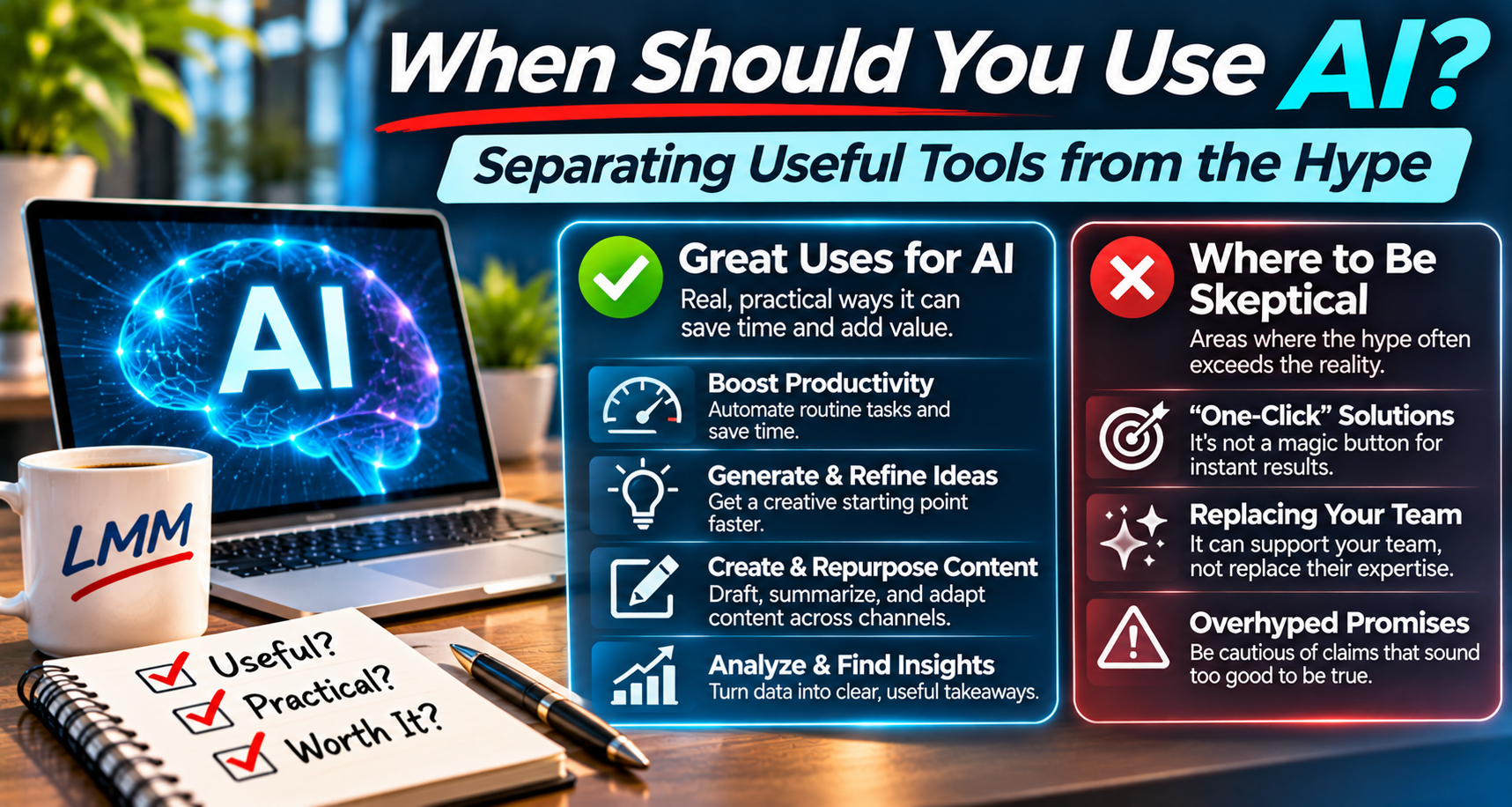
AI is often useful for exploring ideas, organizing large amounts of non-sensitive material, proposing first drafts, generating test cases, and identifying possible approaches to a technical problem. It can help a team get unstuck or compare options more quickly—provided the output is checked.
Where it can be the wrong choice
For a simple image crop, a small CSS adjustment, a precise spreadsheet formula, or a known code fix, a conventional tool or a few lines of code may be faster and more predictable. AI can introduce unnecessary steps, uncertainty, or cleanup. High-stakes decisions involving legal, medical, financial, or sensitive personal information demand especially careful human and professional oversight.
Misconception: AI knows the answer
Language models predict and generate responses from patterns; they do not automatically verify every claim. They may confidently cite nonexistent sources, misread requirements, or rely on outdated information. Verification is part of the work, not an optional finishing touch.
Misconception: AI replaces expertise
An AI-generated logo concept is not a complete brand strategy. A generated code snippet is not a tested, secure application. A polished paragraph is not automatically persuasive marketing. Domain expertise determines whether the output fits the audience, constraints, and purpose.
Misconception: More AI always means more efficiency
Prompts, review, revisions, subscriptions, integration, and error correction all have costs. The right comparison is the full workflow with and without AI—not how quickly the first draft appears.
A practical decision rule
Define the outcome, assess risk and privacy, estimate the time to produce and verify the result, then choose the simplest dependable method. Sometimes that is AI; sometimes it is a designer, developer, standard automation, or ordinary software tool. Good judgment matters more than the label on the technology.